It may well be the biggest storm cloud in the digital landscape: complaints about your webshop. The internet is, after all, a golden place for every irritated consumer. Never before was it so easy to write a complaint and make it publicly known, which means a response does not take long to arrive. What is more, the language quickly turns negative and harsh; people do let themselves go more readily in front of a screen than in front of a person.
Dealing with webshop complaints can therefore be quite a craft in itself. That certainly goes for your customer service staff. In this article we describe 8 tips to help you handle and reduce the number of webshop complaints.
Tip 1: Take a look at the statistics
You probably have a fair idea what most complaints are about, but have you ever properly mapped them out? What are the real pain points your customers run into? How are they resolved? And could that be done better, faster or in a more customer-friendly way?
Complaint analysis
Carry out a thorough complaint analysis. There is a good chance it will bring you new insights for improving your webshop and/or customer service. You can also do such an analysis consistently; once a week, month or quarter. That way you can keep an eye on the trends too. To help you with this, there are many customer service tools that keep these statistics for you automatically. That way you lose less time to the administrative hassle around it.

Tip 2: Communication is key
Research shows that most complaints are about payments, deliveries, returns or warranty. You can probably trace from your complaint analysis exactly what the common complaints about your webshop concern. You will see that, nine times out of ten, it comes down to a communication error. The way you communicate, or the absence of communication, means the customer has a different expectation of the purchase. That creates frustration. So adjust the communication around common complaints. Think of: a clear explanation of the returns policy and any costs involved, clear communication about delivery time, additional costs or warranty period. That way the customer is not faced with nasty surprises.
Tip 3: Attention for the customer service staff
Since your customer service staff respond on behalf of your company, they are also the face of your company. Are you happy with that? Do all your staff respond the way you would like them to? Consistently and with patience, empathy, professionalism? And, not unimportantly, with the tone of voice and the norms and values of your company?
These can be quite complicated matters: it remains human work, after all. One employee will get irritated faster than another. One employee will respond faster, more clearly or more adequately than another. To narrow the difference between one employee and another, it is advisable to schedule brainstorms and training sessions. Discuss particular complaints, and how they would respond to them. Bring up examples. You could even bring in role-play actors for exercises.
Tip 4: Kill them with kindness
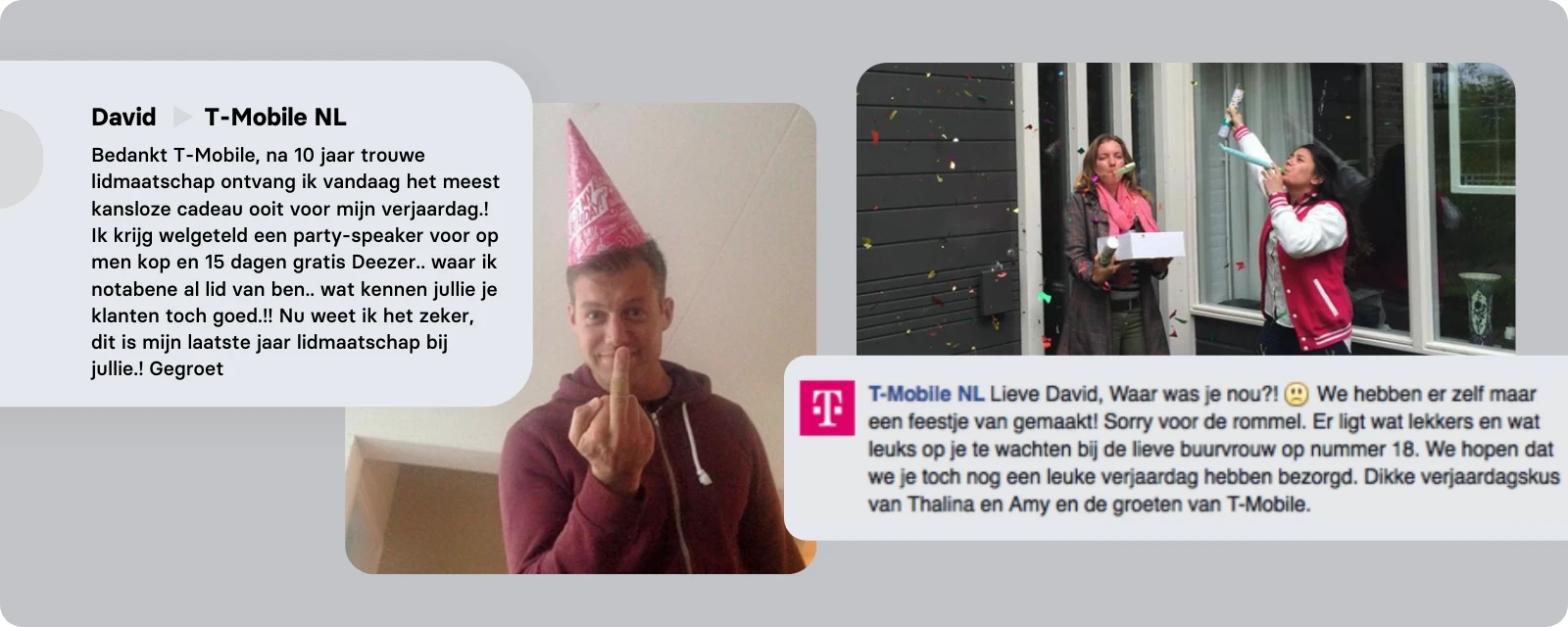
The art of webcare: turning a complaint into a compliment. Not every complaint is equally reasonable; look at David's complaint below, for example. T-Mobile's creative response, however, produced more compliments than complaints. It may be annoying that a complaint is online for the wider public straight away, but your response to it is therefore visible to everyone too. See this as an opportunity, and kill them with kindness!
Tip 5: Respond everywhere, including outside the regular channels
Have you ever googled complaints about your webshop? There are, after all, more places on the internet a customer with a complaint can go, quite apart from the regular channels. Not every customer sends a complaint directly to you, but it is still useful to respond to those complaints. It is therefore advisable to comb the internet every so often for places where you can turn the customer's frown into a smile. Try searching for your company name with a hashtag in front of it, for instance.
Tip 6: Avoid waiting times
The longer a customer has to wait for a response to their complaint, the more the customer's irritation grows. Should the customer choose to put the complaint online publicly, the number of people who see that message without a response from you grows as well. Make sure, therefore, that a customer gets a fast response. Put extra staff on at the busiest moments, so that your customer service does not come under pressure. That way you also prevent an employee having to respond too hastily, losing patience, or not reading the complaint properly for lack of time.
Tip 7: Be easy to reach
Good availability is not only relevant at particular times; we are talking here about broad availability too. From old-fashioned telephone and email to live chat and social media channels: customer service in 2021 has a lot to offer. Customers keep expanding their online presence, whichever audience your customer belongs to. It is therefore far more customer-friendly and low-threshold to be available on the channel the consumer prefers. Fortunately there are also plenty of customer service tools that mean you do not have to switch between all these channels.
Tip 8: A digital colleague
You are not going to tell me this tip surprises you, surely? Of course the digital colleague comes round the corner here as well. A chatbot always responds at lightning speed and is always available, outside office hours too. On top of that, the chatbot responds to every complaint exactly as you want it to; you have the conversations in your own hands, after all. A chatbot will also never lose its patience.
Do pay attention, though! Is the bot responding properly? It is even more annoying, after all, if the customer arrives at the bot with a complaint and is then not helped properly. With the help of artificial intelligence (AI) you can make sure the bot gets smarter and understands more, so that this does not happen.
Interested?
Try it yourself and create a free account.