Every company is aware of the importance of the customer experience. But what does this ‘experience’ actually involve? And what within customer service falls under the customer experience, and what does not? How do you measure a customer experience? How can you best optimise the customer experience? In this article we have lined up all the important points of the customer experience!
What is the customer experience?
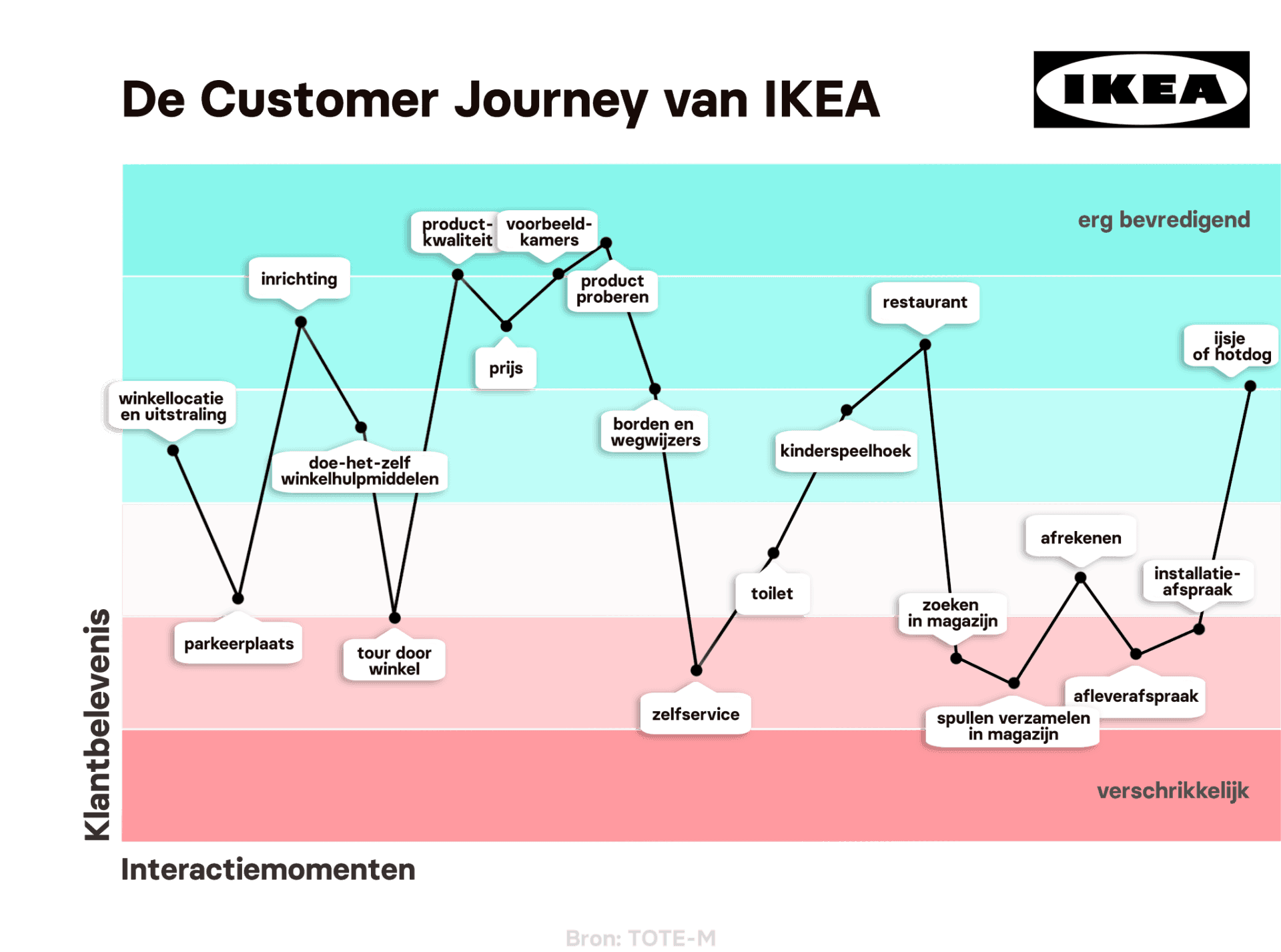
The customer experience consists of all the interactions a customer has with an organisation. In large organisations a lot of attention is paid to the customer experience: there are even specific teams and roles attached to it, such as a Customer Experience Manager. The term ‘customer experience’ (abbreviated: CX) is one that is getting more and more attention. Companies are driven to create a customer experience that is as positive and as unique as possible. There are various instruments for this, such as customer journey mapping and touchpoints. In these the customer journey is mapped out as literally as possible, step by step. The touchpoints are the moments where your customer has interaction with your company. Below we give an example of a customer journey.
The customer experience from beginning to end
Within the customer experience falls the ‘customer journey’. This journey concerns the whole purchasing process a customer goes through. From the moment someone steps into the shop until they leave it. The same applies to online companies: with webshops this runs from the moment a customer finds your company to the moment the postman is standing at the door with a parcel.
An example of customer experience
Online customer experience
Last summer the temperatures rose considerably, and many people realised that the cool spaces on the work floor were a good deal more pleasant than the heat at home. A fan was therefore not a luxury but a necessity! Suppose you decided to order one then. So off to Google. The first search result sent you to Bol.com. You came across a simple but efficient product. Of course you were looking for the best deal, so you compared the price on other webshops. You did wonder whether the delivery time was as fast as at Bol.com, so that you would have the fan in the house as soon as possible. You sent this question in by email. Later that day you still had no response. Your fan was already waiting in the shopping basket, but you really did want an answer to your question first. At 5pm you eventually decided to order the fan from Bol.com after all. They delivered a good service, and your order was in the house at lightning speed. A day later you got an answer to the question you had asked at the other webshop, but that answer was no longer relevant. The purchase had already been made by then.
Contact with support is what is known here as a touchpoint. The positive experience at Bol.com and the negative experience at the other electronics shop form your opinion of the customer journey at these companies.
Offline customer experience
Imagine: you are walking through town and go to the local spring roll stall for a quick snack. The queue is quite long, but that does not matter. You come here often, after all: the owner is always very friendly. There are several places in town where you could also get a spring roll, but because of the seller's friendliness this is your favourite stall.
The seller at this spring roll stall is an important touchpoint here. This touchpoint is so positive that even the long queue is no obstacle. You do not stop to think about it, but it does have an impressive influence on your experience.
The touchpoints in the customer experience
All the points where a customer comes into contact with your company are known as touchpoints. Whether they are big or small, they all influence the customer's experience. This influence differs per touchpoint and varies from positive to negative. More touchpoints are therefore not necessarily better. The focus is on quality. That is why it is important to look carefully at every touchpoint, regardless of size. Make sure every point contributes to a positive customer experience.
How do you measure the customer experience?
Organisations use various ways to measure the customer experience. A few important Key Precision Indicators (KPIs) are the Net Promoter Score (NPS), Customer Satisfaction (CSAT), the churn rate, retention rate and Customer Lifetime Value (CLV). Almost two thirds of companies use the NPS as a measure. This lets companies measure customer engagement. Through the NPS you can measure customer loyalty. This measuring method is fast, easy and simple for customers to use. They simply enter their opinion at the push of a button.
Measuring the customer experience via CSAT and NPS
The NPS is a tool for measuring customer satisfaction. The question asked of a customer here is: “Would you recommend this company/this product to others?” When the NPS is above 0, you have a positive score. An NPS above 50 is marked as excellent. When the NPS comes out below 0 (read: from 0 to -100), you can raise it by improving the overall customer experience. The CSAT, by contrast, is a method often used when the NPS is not a suitable method. Think for example of medical care or government bodies. The question you ask with the CSAT is: “How would you rate your experience with the product/service?” The customer then enters a number from 1 to 10. The higher the number, the better the customer experience. In the overview below you can read how to lift this score.
A better customer experience in 3 steps
You optimise your customer experience by following the three steps below. It gives you something to hold on to and a clear insight into exactly what your customer is dealing with or running into.
Step 1: Customer Journey Mapping
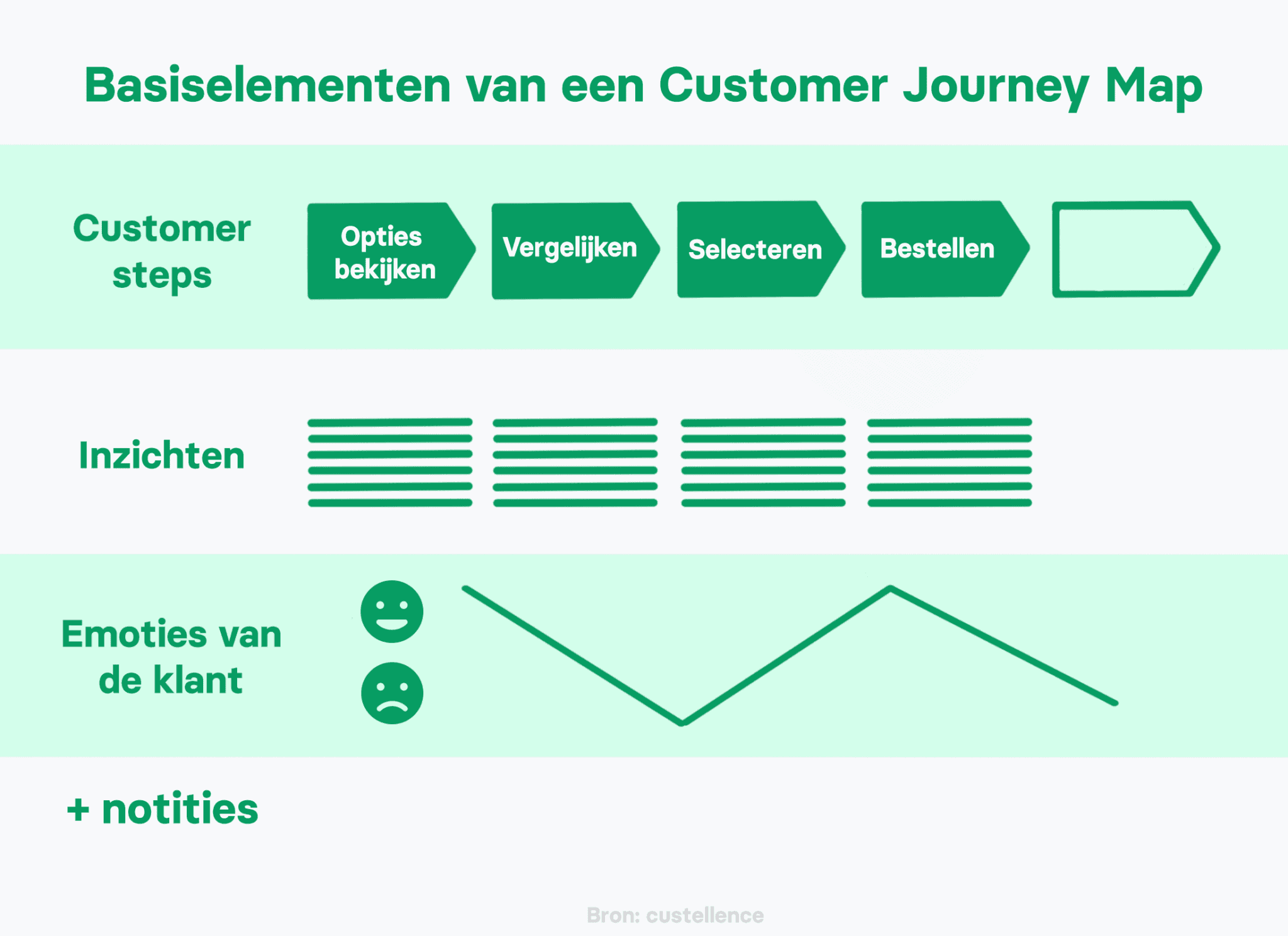
First of all it is important to gain insight into the customer journey. Gaining insight into the customer's experience is also called Customer Journey Mapping. With this strategy you map every touchpoint, however small it is. By mapping the customer experience you get a view of the phases the customer goes through. This lets you see faster where obstacles arise and where you can improve for an optimal customer experience. Customer Journey Mapping often happens on paper. In it you place the right touchpoints in the right phase. These phases consist of awareness, consideration, purchase, delivery and loyalty.
Step 2: Analyse points for improvement
After you have mapped all the touchpoints, you start thinking about the points for improvement. Ask yourself concrete questions in this process. Where in the customer journey do you see people dropping out? Is the customer journey simple enough for the customer? How does your current customer journey run? Where is the starting point for your customer? Do they close your webshop when their shopping basket has not yet been paid for? This is perhaps a sign that your customer needs assistance in the purchasing process. By thinking about where your customer hesitates or runs into complications, you offer targeted solutions to give your sales a boost.
Step 3: Reflect and update
After the extensive reflection of step 2 you have all the points for improvement in a row. In step 3 it is time to carry out updates. It is important here that you keep reflecting; your result may already have improved by now, but it can always be better! When you have made adjustments, you go back to your Customer Journey Mapping. Has the problem been resolved or are there new points of attention? When creating new touchpoints, new exit opportunities for your customer sometimes arise too. You want to map these as well, so that you turn the possible exit into a smooth flow. That way you are continuously optimising your customer experience.
Tools for improving the customer experience
To lift the customer experience to a higher level there are, alongside the measures the NPS and CSAT offer, other ways to improve. Companies make use of customer experience tools. A customer experience tool differs per provider. When you use Watermelon you centralise all your customer contact in a multifunctional conversation overview. From this conversation overview you handle all your customer questions spread across all your channels. On top of that it is possible to have a chatbot catch the first-line customer contact. Your chatbot stands ready 24/7 for your customers and responds immediately. You improve the customer experience with consistent customer support. You build the chatbot without having to program yourself: that way everyone is able to build the best chatbot. On the basis of extensive statistics you reflect on your performance and optimise your service. This way you give your service a boost and improve the customer experience.
You improve the customer experience by measuring, optimising and reflecting. Watermelon lends a helping hand here. Thanks to a digital assistant you improve your service department by offering an immediate response time to your customers, 24/7. Would you also like to improve your service with Watermelon? Try it yourself and create a free account.


