Whether or not you meet your customer's expectations in 2021 determines the success of your webshop. Consumers moved online to order en masse in 2020 and there is more competition in the e-commerce landscape. The number of webshops rose in 2020 by an impressive 21 percent. Your customers' expectations are changing because big players in the market are raising the standard. In this article you can read the most important pillars for the online customer expectations of 2021.
1. The customer experience is central to online customer expectations
A term that is by now impossible to imagine the e-commerce sector without is the customer experience. The customer experience is closely linked to the success of your webshop. Your customers expect a good service at every moment of the customer journey. An important part of a holistic customer experience is an omnichannel strategy. Research shows that customers hop from one channel to another. Your customers expect a good service on every channel. By aligning your different channels and touchpoints with one another, you improve the complete customer experience.
Omnichannel strategies improve the customer experience
An omnichannel strategy offers customers the possibility of doing business with your company through various channels. These channels are aligned with one another in order to give your conversions a boost. Did you know that 73 percent of customers make omnichannel purchases? The omnichannel customer spends up to 10 percent more online. So align your channels well and make sure you offer a consistent customer service on every channel. Furniture giant Ikea responds to omnichannel too. Alongside their familiar paper catalogue they have a digital version on the website. On top of that they have an Augmented Reality function with which consumers can place the furniture digitally in their own rooms. By aligning your channels seamlessly through customer service software, for example, you create a better customer experience and respond to your customer's online expectations.
Read more about the customer experience in the article ‘The e-commerce trends of 2021’
2. Personalised online shopping experiences
Go from too much choice to the right choice. Never overwhelm your customers with too large a range. Customers expect a personal service, with personal product recommendations. Just as in a physical shop, online too you want to see straight away the products that are interesting for you. In a physical shop the shop assistant takes care of this, by assisting you with your purchase. More than 50 percent of online shoppers say a personalised online shopping experience is important.
Create personal shopping experiences with artificial intelligence
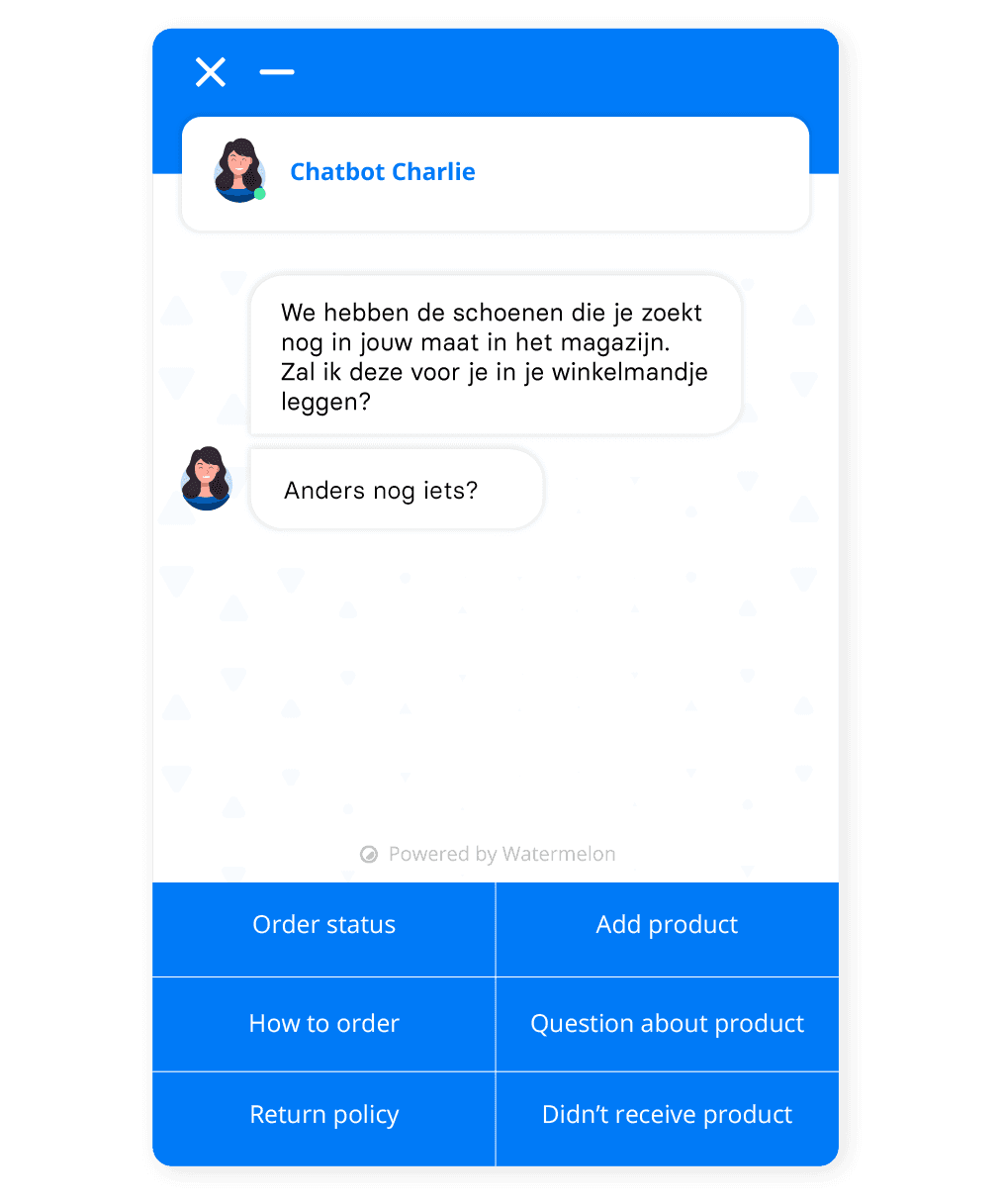
Artificial intelligence can be a valuable addition to the e-commerce sector in many respects. Thanks to this technology you discover which products are favourites with your customers and easily make product recommendations that score well. By analysing buying behaviour, artificial intelligence predicts your customers' next purchase. An AI chatbot also supports the personal shopping experience, because the bot acts as an online shop assistant. By means of smart technology, the chatbot guides the customer around your webshop, as in the example below. With artificial intelligence you create a customer-centric shopping experience at scale.
3. Fast deliveries without paying extra
Your delivery method is the biggest dealbreaker for customers. Delivery time is the most important player in the shipping process. The average Dutch consumer expects a standard delivery of no more than two days. Delivery costs that are too high are the biggest reason for your consumer to abandon their shopping basket. For a faster delivery, 36 percent of Dutch people are therefore not willing to pay extra. More than half of consumers leave a full basket behind when the delivery costs are experienced as ‘too high’. Consumers mind less when a product is unavailable than when the promised delivery time is not met. Honest and clear communication about your delivery time is extremely important. Pay attention to the right form of communication to your customer. The description ‘ordered today, delivered tomorrow’ scores better, for example, than ‘ordered today, dispatched today.’ Your customers expect a fast but also cheap delivery. When you do not meet this expectation you miss out on conversions.
Empty full baskets with a smooth checkout
To meet your customers' expectations it is important to adjust your cut-off time to their needs. The cut-off time is the time up to which customers can place their order for next-day delivery. The Dutch consumer expects to be able to place an order until around 7pm for delivery the next day. Besides the cut-off time it is also important to take a look at your delivery costs. Dutch people expect lower delivery costs when the value of the order is higher. Respond to this by offering free delivery from a certain amount. If you do this cleverly it can also raise your turnover.
In Europe an average of 70% of consumers are inclined to add an extra product in order to get free delivery
4. Simple payments for e-commerce
iDEAL is still the most used payment method in the Netherlands. There is a chance, though, that the payment method will have to make way for Apple Pay or Payconiq, for instance. Your customers expect your webshop to have a broad palette of payment methods. Your payment methods should not only fit every customer's wish, but also be easy to use. Apple Pay is gaining a lot of ground here, thanks to the user-friendliness of the payment service. Create a broad and user-friendly payment process so that your customers do not drop out in the final phase of the purchase.
How do you make the payment process as simple as possible?
Paying via chatbots, also known as conversational selling, is going down well with large e-commerce players. Mastercard uses conversational selling for handling customer payments, for example. A payment chatbot answers customer questions and supports customers in making in-app payments. By offering conversational commerce on your webshop, you assure your customers of an easy payment process. Consumers turn out to appreciate conversational selling: 47 percent of users say they are open to payments via a chatbot. Customer satisfaction rises quickly when payment processes are simplified. Do you use payment providers such as Mollie, Adyen or Buckaroo? Then easy chatbot integrations are already available for these on Watermelon's chatbot platform. With this code-free chatbot you easily respond to the conversational trend.

Responding to customer expectations in four steps:
Step 1: Create an omnichannel strategy - By aligning your channels seamlessly, you create a better customer experience and respond to your customer's online expectations.
Step 2: Implement artificial intelligence for personal shopping experiences - Thanks to this smart technology you discover which products are favourites with your customers and easily make product recommendations that score with your customers.
Step 3: Go for a conversion-raising checkout - Align your delivery costs and cut-off time with your customer's expectations.
Step 4: Make the payment process easy - By offering conversational commerce on your webshop, you assure your customers of an easy payment process.
An overarching theme in the steps above is the importance of the customer experience. When all your touchpoints are aligned with one another you achieve more conversions. This runs from social channels to the last step in the customer journey: the payment. Meeting your customers' expectations is challenging, but important. With Watermelon's platform you easily create a multichannel service and respond to conversational selling. Curious to know more already? Try it yourself and create a free account.


