Admittedly: we would be throwing stones in our own greenhouse if we said ‘yes’ to the question in the title. And we understand that you are now thinking: of course they are going to say none of it is true, they are far from impartial. But let us surprise you: some prejudices are true. This has everything to do with the implementation of the chatbot, in combination with expectation management. To settle the untruths around chatbots once and for all, we have therefore lined up the biggest prejudices in this article, and how we deal with them. And to give you a complete picture of it, we also let our customers have their say.
Prejudice 1: “A chatbot never understands the question, you keep going round in circles.”
We start with perhaps one of the biggest prejudices around chatbots. A chatbot never understands the question. And sadly there are plenty of examples of chatbots that contribute to this prejudice. The explanation is simple, though: a chatbot cannot answer the question if it does not know the answer. Instead the bot will link your question to the best possible answer.
How we do this differently
We have various working methods for avoiding this scenario. On top of that, the number of ‘mismatches’ is tracked in the platform. By a ‘mismatch’ we mean a customer question the chatbot did not know the answer to. ‘Clearing away mismatches’ is therefore a much-used term in our office: by adding the missing knowledge, the chatbot will know the answer next time. That way we make sure the customer continuously optimises the chatbot, and can help more and more customers.
Prejudice 2: “A chatbot is not personal.”
We understand that customers prefer personal contact, with a flesh-and-blood member of staff, over a chatbot. We also understand, though, that this often means the customer has to wait a long time for an answer, because it is labour-intensive to deal with everyone personally. And those long waiting times are no longer of this era. That means either an enormous scaling-up of the number of customer service staff, or automation.
How we do this differently
We therefore encourage our customers to make the chatbot as personal as possible. This starts during the onboarding; we create a character that fits the company. This bears fruit: our customer AMP Groep has created such a detailed digital employee that they notice their customers often do not see the difference from a real member of staff.
On top of that, in our platform you can choose to pass the question on to a member of staff when the chatbot does not understand it. That way the customer gets a fast answer to the general questions, and a personal answer to the complex ones.
Prejudice 3: “Our customers just want a human on the phone or by email.”
“Enough with that chatbot, I just want a human on the phone!” This is a remark we regularly see coming past on our social media channels.
When we then ask ‘but why?’, it usually has to do with bad experiences with chatbots that do not understand the question. These customers say they want to speak to a human because of ‘instant gratification’. That is to say: people want an immediate result. They want a fast answer. In this fast, digital world that is not an unusual trend either.
How we do this differently
We already mentioned clearing away the so-called mismatches. Another way in which we make sure the chatbot knows the answer is with the help of artificial intelligence. While the chatbot is being used, the bot learns to understand the customer's various questions better and better. You do not have to do anything further for this. The number of customer questions answered automatically while the chatbot is live grows. At our customer Logistiekconcurrent, for example, the number of customer questions answered automatically stands at 70%. Rody Hermkens (Head of Marketing and Communications): “The Loggi/employee combination is so well balanced these days that we can keep our customer satisfaction guaranteed high.”
Prejudice 4: “A chatbot is not suitable for us, because we get too many different questions.”
Admittedly: building a chatbot is easier when all the customer questions you receive fall under some five frequently asked questions. That this is easier does not mean, however, that automating a wide diversity of questions is impossible. It simply costs you a bit more time to teach the chatbot the answers to these questions.
How we do this differently
Our platform works in such a way that you can build in various conversations. Every customer question, including the different answer options, can be taken into account in it. On top of that, the artificial intelligence makes sure the chatbot understands question variations too, so that an answer can still be given.
Prejudice 5: “A chatbot is bad for customer satisfaction.”
When a chatbot is not implemented properly, the statement above is certainly true. In that case your customers do not get the answer they are looking for, and they are stuck in a ‘loop’ of the same answers. We would be endlessly irritated by that too.
How we do this differently
To prevent this we have an extensive onboarding process. In it we make sure the chatbot is implemented as well as possible and tested thoroughly. Once the chatbot is live, our Customer Success Managers make sure our customers get everything out of the chatbot and keep optimising it continuously. We dig into the statistics the platform offers with them, and make sure the chatbot produces higher customer satisfaction. More than 85% of PureLou's customers say they were helped well by Chatbot Vilou.
Prejudice 6: “Building a chatbot takes a long time.”
Building a chatbot can be a long, expensive process. It does not have to be, though. In many cases it involves a custom-built chatbot, with a development team involved as well. Certainly when artificial intelligence is on the list too, this can be a lengthy, expensive process.
Again: it does not have to be.
How we do this differently
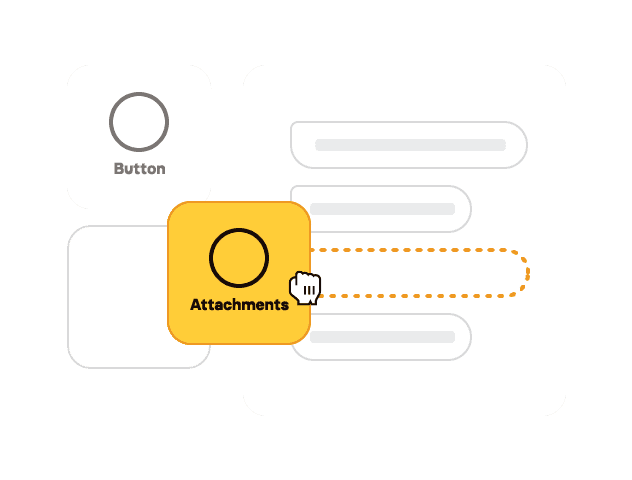
We have developed a chatbot platform that every customer can run with. Thanks to easy ‘drag-and-drop’ software you no longer need a development team to be able to build a chatbot. The user-friendly software can be used by several people and works quickly and efficiently. As our customer Jolijn ten Have (USG Freelance) said last week: “I thought it was a lot of work, but once you get the hang of how it works, it can go very fast!”
Want to know more?
Not finished reading? Read our whitepaper: How companies use chatbots successfully.


