Watermelon has grown enormously in a short time; we have been through various phases in the company and the market. A market where the chatbot was still ‘scary’ and unfamiliar, but also a market of enthusiasm for chatbots. A market in which companies are keen to get a taste of that new technology. That is also the market we are dealing with at the moment. We are clearly one of the biggest chatbot players in the Netherlands. Our customer base has also grown enormously by now; we are active in almost every different sector in more than 30 countries. This also produces fine examples of how chatbots can be deployed, and we have already developed a number of interesting customer cases.
Watermelon is always developing further, and in doing so we pay particular attention to developments in the market and try to respond to them as well as possible. What we see is that a large number of companies are interested in the possibilities of chatbots but would like to keep the risks low. On top of that, a lot of providers have appeared in a short time who are not yet so far along with their software and therefore often offer chatbots with technologies that were already available in 2005.
Watermelon remains the most user-friendly platform, but until now was not easily accessible for smaller companies, partly because of our pricing and intensive onboarding. After a year and a half it was time for reflection, reflection on the market, but also on our own business model. We concluded that we want to offer our product to a broader market; every company should be able to place a chatbot on their website! Big or small, it should not matter. That is why it is time to usher in a new chapter: Hyper Growth. In a short time we have got our product and team ready for the Hyper Growth we are going to go through (more about that later); first I want to share my reflection on the market with you. What exactly does that chatbot look like?
Development of new technology
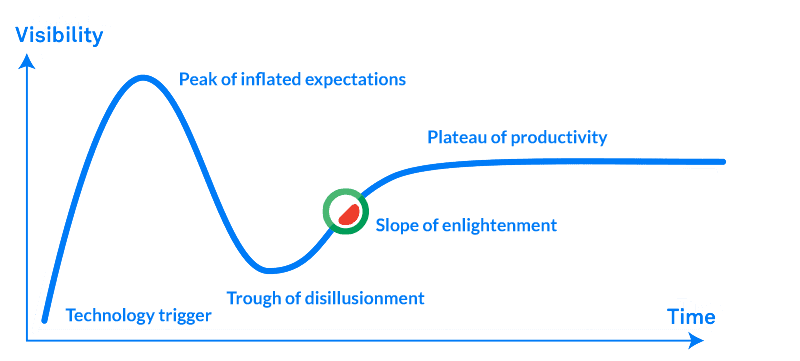
To describe the chatbot market, it is good to take a step back; we look at how the technology came about and how it developed. Research agency Gartner developed a Hype Cycle for new technologies. When a new technology is introduced it is always a question whether it matches people's needs and whether it is really sustainable. The Hype Cycle gives a representation of how new technologies develop.
Before we look at where chatbots stand on the Hype Cycle, it is good to get a picture of the five main phases a technology goes through:
Chatbots on Gartner's Hype Cycle
The Hype Cycle starts with an Innovation Trigger. This trigger is a technology or another innovation that arouses interest in parties. The commercial viability of the technology has not yet been proven, which is why not everyone will pick the technology up yet. To form a picture, we look at a current Innovation Trigger: new developments around the pilotless flying car. Is this a development the world is ready for? No, absolutely not. The (air) roads are not ready for it, people themselves are not ready for it, manufacturers need new machines, and so on. This does not rule out that it is the beginning of a technology that is going to make an enormous impact on the way we transport ourselves and our goods.
After this trigger more parties will pick the technology up bit by bit. Popularity grows and commercial feasibility is established. Success stories arise. These successes will dominate the media until the dust settles again. Comparable to when you buy a new phone yourself, for example. At first it is new and wonderful and you are happy with it. The more often you use the phone, the more disappointments you come across. A camera that is not as good as the advert claims and a memory that fills up very quickly after all. That is how it goes on the Hype Cycle too. At the top of the peak of enthusiasm, critics appear. This goes hand in hand with negative media attention and ‘failed’ stories. The new technology seems not to live up to expectations after all and popularity drops after this peak. This peak is called the Peak of Inflated Expectations. The faster something rises in popularity, the faster it drops again too. High peaks have deep troughs. A number of companies do keep working with the technology and take action; other companies choose not to take the risk.
After a lot of negativity the technology reaches a low point, a trough, the Trough of Disillusionment. The experiments that have been done with the technology do not lead to the desired results. Producers of the technology fail or decide to stop. Investments do keep coming, but only for the producers who improve the products for the Early Adopters. These are the group of people who pick up a technology or trend first. They always want the newest of the new, even when the quality has not yet been proven. Despite the negativity there remains a glimmer of light on the horizon with the thought: ‘The technology cannot live up to what we thought, but it is an interesting development’. A technology that finds itself at this point is Augmented Reality. Augmented Reality is enormously popular, but it may take another 5 to 10 years before it really conquers a place in the market.
In the deep trough there are still investors who believe in the technology and producers who are determined to improve the products. This eventually bears fruit. Cases come to light of how the technology can help companies and a broader understanding of the technology arises. Several companies see this, after which more producers appear. This growth is slower than at the start of the hype, but it is stable. This is called the Slope of Enlightenment. The innovation simply crawls up a slope with the help of ‘real’ success stories.
From the Slope of Enlightenment you arrive at the Plateau of Productivity: the mainstream takes the technology over. On top of that, viability is clearly defined. The technology is stable and several companies experience the benefits. Of the potential users, 20 to 30 percent have the technology in use. On top of that it is clear whether the technology is more broadly deployable.
For many people the word hype suggests something short-lived. The fidget spinners that are all in the bin by now, the strangest planking photos and those Fortnite dances: these are crazes and not a hype. How long it takes before the Hype Cycle has been completed, and whether a technology goes through it at all, differs per technology.
Chatbots on the Hype Cycle
An innovation starts with a Technology Trigger. For a chatbot this is not the first trigger; the real trigger goes further back. In 1956 Nawell and Simon invented the ‘Thinking Machine’. The first program that simulated the human quality of solving complex matters. This is the first program with artificial intelligence. This development is of course remarkable, but hard to grasp. Then the question remains: is society ready for this development?
The first chatbot went online in 1966; she was called ELIZA and was born almost 20 years (!) before the internet arose in its current form. After ELIZA come success stories where everyone is mainly enthusiastic about the ‘new’ technology. Consumers also come into contact with it more and more and interest rises. A.L.I.C.E. (1995), a natural language processing chatbot based on ELIZA, won the Loebner Prize three times. A prize based on the Turing test, a test that determines how human a chatbot is. In each round of the Loebner Prize a (human) juror holds several conversations with a chatbot and a human via a computer. On the basis of the answers the jury determines who is the computer and who is the human.
In a short time (15 years) after A.L.I.C.E. all sorts of chatbots spring out of the code. Do you remember Clippy? Every time you opened a Word document Clippy came to help you and told you where the recycle bin was. Meanwhile Microsoft has found that recycle bin itself and Clippy has disappeared into it.
At the time MSN came up, it became clear how chatbots can also be deployed as entertainment or a social device. Telephone provider HI promoted Chatman heavily and I can still remember the advert well: ‘I am Chatman, super fast with MSN, there is nobody who does not know me.’ This way we got acquainted with chatbots in a fun, low-threshold way. Via MSN we could also talk to Marco Borsato in the form of a chatbot.
Although the Hype Cycle indicates a tight line, this line can of course still fluctuate in between. In April 2016 Facebook Messenger launched a platform for developers with which you can make a chatbot. This way more consumers can come into contact with companies by talking to a bot. This is a kind of trigger that brings the technology closer to people and makes interest grow.
Around this period Watermelon also starts with research and development; this is connected with the acquisition of Ecreation by Watermelon. Watermelon develops the first generation of the product. Randstad is the first success story; we built a custom-made chatbot. We learned a lot from this. We learned what we as Watermelon want to offer and what the business market is asking for. Parties such as IBM and Microsoft were already offering possibilities for building a chatbot. With Watermelon we want to make this technology available to everyone, without needing coding knowledge for it. In 2018 we launched the first version of our Chatbot Management Platform.
A trigger such as Facebook Messenger's can cause a peak. A peak in the early phase of a product's development almost always means the same thing: the way down is easier than further up. The media reinforces this enormously. The software of Watermelon and other suppliers is still in its early phase at that moment. There is a lot of interest in software for developing a chatbot with. With all this interest, a lot of critical people too. Headlines such as ‘Why are almost all those smart chatbots still so stupid’ appear.
This negative attention always seems very fierce, but the demand from consumers continues to exist. Just think of the video made in 1998 by Frans Bromet. In this video various people said they found the mobile phone ‘unnecessary’ and ‘a waste of their money’. Can you imagine a world without your smartphone now?
We realised this at Watermelon too. Despite a number of critical headlines we still believe in our product and what it can mean for companies and consumers. We believe that Watermelon makes customer service better, faster and more enjoyable. That we are succeeding in this from the launch of the Chatbot Management Platform is confirmed by our customers. Nummer Een was the first to join the first version of our platform. Now Chatbot Robin still helps the customer service department. Stichting BKR is one of our first customers and their Chatbot improved their customer service considerably. BKR's chatbot catches 300 conversations daily. Conversations that previously had to be held by a member of staff. Interest is rising and Watermelon's place in the market is clear. A variety of small and large companies from different sectors now know how to find us. From a bank such as Chaabi Bank, to insurer VGZ, to schools such as HAN and TIO. AFAS Software now also communicates with a Chatbot via WhatsApp that they made with the Watermelon platform. Soon you will be able to find out everything about pizzas via Domino's Chatbot and PepsiCo employees can ask questions about HR policy, for example, of their HR Chatbot.

Koen Gebbink and Maureen van den Bergh of Stichting BKR, read the business case here.
Past the hype?
When ‘the hype is over’ is said, it may seem as if the interest is over with it. This is not the case at all! It only means that the technology has now become stable. Watermelon, the market and consumers have learned lessons from the past. Society is ready for it and the market joins onto that seamlessly. We are now entering the Plateau of Productivity via the Slope of Enlightenment.
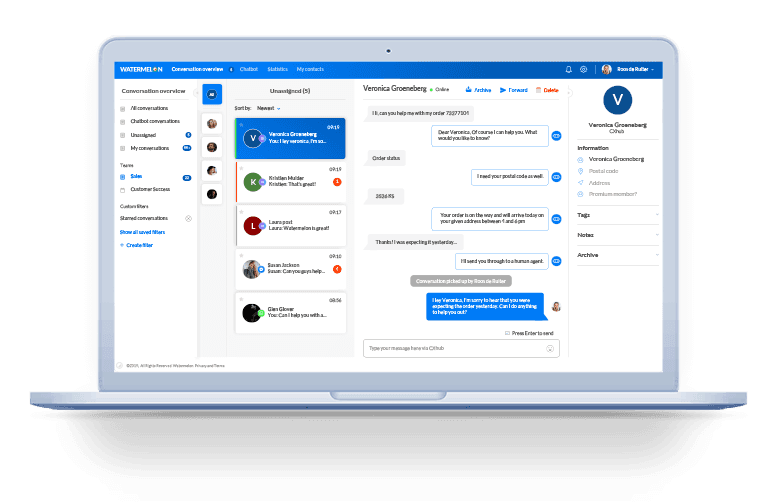
The first platform only contained the possibility of adding Frequently Asked Questions. With the knowledge gained from the first platform we launched the second generation of our platform in 2018. With this we added the possibility of building conversations. We have learned much more, though, in developing the product further. We discovered that it is not directly about how smart your AI is, but about the content you add. This is also one of the reasons that we start a Customer Success process with every customer. Sometimes the lessons seem very simple, but they make an enormous difference. We decided to delay the chatbot's response by a few seconds, for example, which makes it look as if the chatbot is typing. The chatbot immediately comes across as a good deal friendlier.
The most important lessons have contributed to the creation of the Hybrid Model, the most distinctive part of our platform. We are aware that a computer cannot yet solve every question and that sometimes you simply need to talk to a human. For this Watermelon developed the Hybrid model, which lets a live agent work seamlessly together with a Chatbot.
The success of a Chatbot is in essence determined by the content a Chatbot contains. You can really see it as a new employee you have to coach. You teach your new colleague everything about his or her new workplace. The moment this person starts working independently, questions come up again after all: ‘Where can I actually print?’, ‘How do I answer the phone?’. It is sometimes hard to judge what exactly will be asked, and this applies to a chatbot in customer service too, for example. While you are convinced that a customer wants to know the delivery time of his new sofa, he actually wants to know whether this sofa can also be picked up somewhere in a shop. You have not yet taught this information to your Chatbot. Through the Hybrid model a question like this is automatically forwarded to a member of staff. You can tell your customer that the sofa can indeed be seen and obtained in a shop. Your customer is helped straight away and there is a good chance the sofa gets sold! Win-win, then, for you and for your customer.
Precisely in a market like this where a large part is automated, it is interesting to have a Hybrid model. When someone expects an immediate answer, he or she can start a conversation via a Chatbot. More complex questions are forwarded to a live agent.
That last target group in particular is much larger than many companies think. Research by the Capgemini Research Institute shows that 70 percent of consumers will gradually replace a visit to a shop or bank with a conversation with a Chatbot within three years. It is clear what the consumer wants and with a good, stable platform only one question remains: what are the companies waiting for?
A look at the future
If we look at the future, a number of fine developments are coming. Gartner has already indicated that in 2020 85% of customer service will have been taken over by virtual assistants. That means your customer service department can really focus on the consumer and on serving them as well as possible. That sounds completely wonderful, doesn't it?!
The third generation of our Chatbot Management Platform is going to have a lot of impact. We realise that a chatbot is interesting for every company, large and small. That is why we have decided to overhaul our business model. This means that you can now build a chatbot from €45. We are much more than a Chatbot Management Platform, so the name has now also changed to ‘All-in-one platform for online conversations’. We offer four different packages: Forever Free, Watermelon Essentials, Watermelon Team and Watermelon Professional. The product has been optimised to the point that every user can get going independently entirely from within the product. The Customer Success process is offered with Watermelon Team and Watermelon Professional. This does mean that we can now offer our user-friendly platform to every company, small or large.
On top of that our development team has worked extremely hard on developing free fields. By adding free fields to our platform the chatbot can retrieve all sorts of data independently. Data you previously had to call or email for. Do you want to look up the location of your winter tyres, for example? With a verification of your registration number and postcode via a chatbot you are on your way again in no time! Or do you want to know which lessons are cancelled in your timetable? Send your student number to the chatbot and receive the cancellations straight away. This way an even larger part of customer service can be automated.
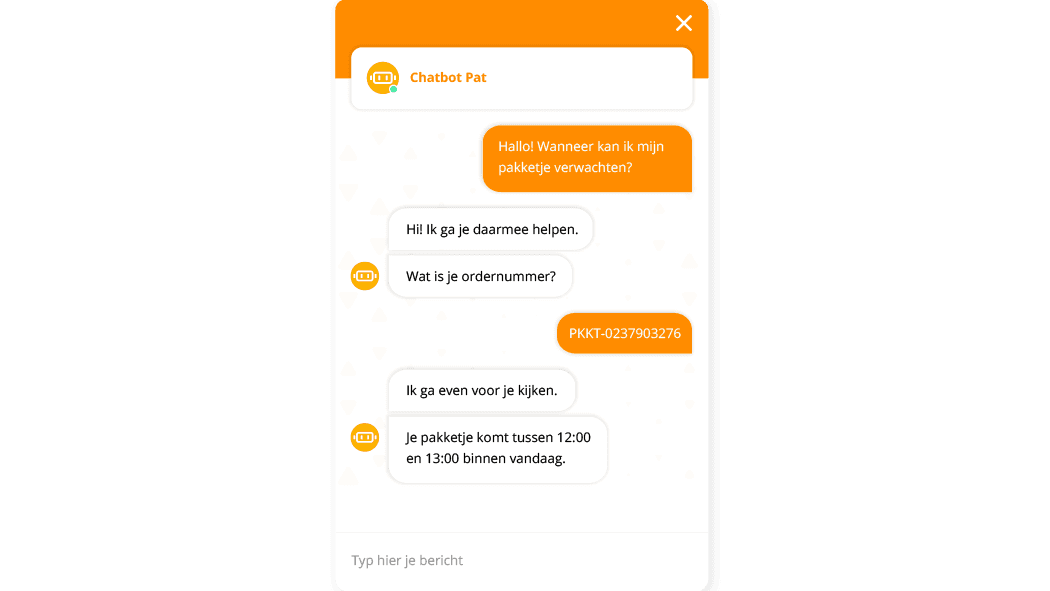
Chatbot Pat helps customers even better through free fields
A question I get more often is whether Watermelon can also be integrated with different Voice providers. Although I see that Voice is still in the early stage of the Hype Cycle, we have developed a lot in this over the past period. You can integrate Watermelon with Google Home, for example, and this brings fine opportunities with it for many companies.
Are you ready for the conversation?
Watermelon has only existed for three years in total, but if you look back with me like this, you can see how far our product has developed. We have a true place at the table in the chatbot market. We understand how the market works. We hear from companies what they want to see and we understand consumers' needs. With all this knowledge and with the lessons from the past and the lessons we experience every day, the future looks good. We now have a stable product, which means we will only keep developing further. Watermelon is available to every company, so really only one question remains. We are ready to start the conversation; are you?
Try it yourself and create a free account.


