The chatbot deployed in the customer service department is familiar to all of us by now. And that is no surprise: the chatbot has proved itself a worthy colleague within customer service. Because of that prominent role, though, we overlook a number of other interesting roles. How about a chatbot for your marketing or sales department, for instance?
In this article we therefore sketch a better picture of the marketing and sales chatbot, and go into the benefits in more depth. You can also read examples here of other companies that use the chatbot in this way.
A marketing and sales chatbot: what does it actually involve?
Customer service departments are largely reactive in nature. When the customer runs into something during the purchasing process, the customer service department is there to support them. The marketing and sales chatbot contributes to the goal of approaching website visitors proactively and thinking along with them. This chatbot can be an extension of your marketing campaign, for example. If you have a Halloween campaign running, you can carry that through to the chatbot by giving the chat widget or the chatbot persona a Halloween theme. A chatbot can give your marketing strategy a boost.
The goal of the chatbot
Keep the goal of the chatbot in mind here. We mostly see cases in which the chatbot is used to handle frequently asked questions. That is a logical choice, but not the only one. When the chatbot's goal is to increase the number of leads, it will be built differently. A chatbot focused on leads will be quicker to ask the customer for details, so that they can be called. A chatbot focused on marketing will be quicker to ask for an email address, so that the customer can be taken into the email marketing. So set clear goals for the chatbot before you build it.

Examples of a marketing chatbot
Many large companies already use the chatbot for marketing and sales purposes. These chatbots fulfil a sub-goal within the marketing strategy, so that they make a positive contribution to the customer journey or to conversion.
KLM
KLM's chatbot, called Fly, supports website visitors in finding, booking or changing their flight. Thanks to the calendar function, the website visitor can indicate a date, which keeps finding a flight within a single chat window. The chatbot can also take account of booking seats next to each other when the booking is for a group. KLM claims that in five years they have collected more than five million clicks with the chatbot. Chatbot Fly guides website visitors easily through the entire purchasing process.
Vb&t Makelaars
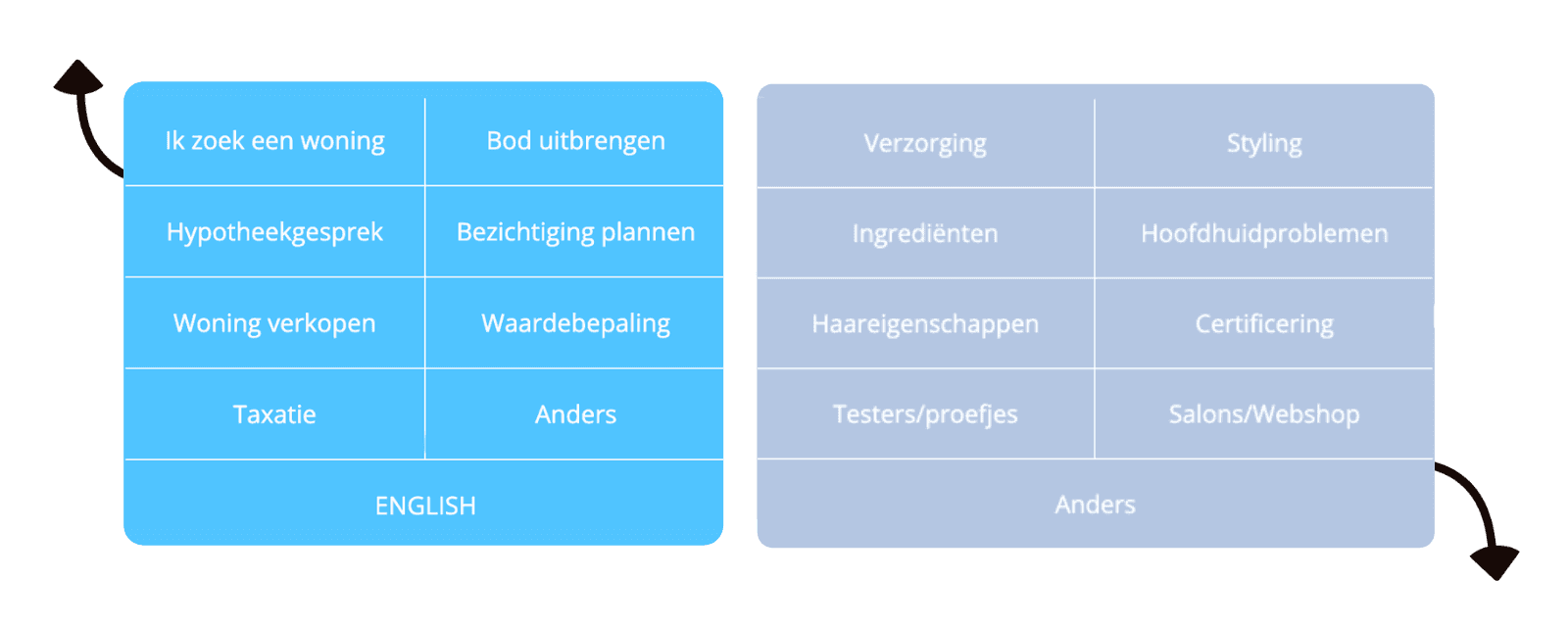
The chatbot of Vb&t Makelaars starts the conversation as soon as you arrive on the website. The website visitor then has various options: they can search for or sell properties, make an offer, schedule a viewing, book an appointment for a valuation or appraisal, or request more information about the processes involved. Thanks to the chatbot's proactive approach it plays a valuable role in the marketing strategy: it guides the customer through the sales process and can request information that may be of interest for sales purposes.
The campaign bot
Once the chatbot is up and running, fun marketing campaigns can generate more traffic to it. The goal, after all, is that people start using the chatbot and so move further down the sales funnel. Over the past year we have used our chatbot in various ways for marketing and sales purposes. That way we have caught the attention of our potential customers and shown how our chatbot works. Missed the campaigns? We have lined them up below!
The Sintbot
The Sintbot has its own website and can answer any question about Sinterklaas. Questions about his arrival, his helpers, his age or his horse: the bot answers every question with just as much patience as the real Sinterklaas would. Together with the Software Pieten, the bot gets one question after another thrown at it; oddly enough, the bot is used all year round. Although the bot sometimes has to think for a moment about an answer (what do you say, after all, to “can I pull your beard?”), it is a good illustration of how our platform can be used for marketing purposes.
Blue Monday
The third Monday of January is seen as the most depressing day of the year: a short day that is often experienced as a dark one, the holidays have only just finished, holidays away are still far, far off and most new year's resolutions have already been thrown out of the window. To cheer people up a little on this gloomy day, we taught our chatbot all sorts of jokes. The quality of the puns may be open to debate, but they undoubtedly produced plenty of grins.
Black Friday
Black Friday: the biggest opportunity and the biggest nightmare for many e-commerce companies. To support them in these busy times, we filled chatbot Melony with tips, tricks and articles they can use for Black Friday. How do you make the most of live chat? How do you keep an overview during peak moments? How can a chatbot help during the rush, and how do you prepare it properly?
Want to know more?
Would you like to know more about how to use a chatbot for marketing or sales? Read more about the benefits of chatbots in our whitepaper!


